Resource management reform
Topics
3 min read

The Coalition Government is making changes to the Resource Management system. DairyNZ made an extensive submission to this process and will continue to engage with ministers and officials. This webpage outlines our core concerns and information on the process ahead.
The Government has introduced Bills to replace the Resource Management Act 1991 with two new acts:
The intention is to pass Bills into law in mid-2026. The Select Committee process will be the main mechanism for public consultation. The closing date for public submissions was 13 February. We anticipate several changes will be made through the Select Committee process and we will work with Ministers and officials to deliver for levy payers.
DairyNZ is supportive of Resource Management Reform. We are seeking enduring policy solutions that deliver environmental improvements and enable productive growth for the sector. We support the Government’s intent of a more enabling system. However, we do not believe the current drafting delivers on Ministerial intent.
Our view is that dairy farming should be managed within appropriate, science‑based and outcomes‑focused environmental limits. In most catchments, a mix of Freshwater Farm Plans, national standards for common dairy activities, permitted pathways for low‑risk activities, and catchment‑led actions provides a sufficient framework to improve ecosystem health.
We are working across the primary sector to provide informed and constructive feedback through the select committee process and engagement with ministers and officials.
Intended flexibility undermined by current drafting
The Natural Environment Bill provides tools to deliver a cascading framework for intervention based on the extent of freshwater issues in a catchment or management unit:
Current drafting fails to deliver on this scaled approach. Voluntary methods, permitted activities and Freshwater Farm Plans are not appropriately recognised in the legislation as effective replacements to resource consents (or permits), risking duplication. In overallocated catchments, the legislation directs Regional Councils straight to caps on resources. As discussed further below, Action Plans are more regulatory than non-regulatory, and we are seeking deferral of new market-based mechanisms.
DairyNZ are proposing drafting changes that prioritise enabling low-risk farming practices.
Concerns around Permitted Activities and Consents
The intent of the bills is to simplify and make the consenting system faster and easier as well as make more activities permitted so less consents are needed overall. We agree with this intent but as currently drafted the Bills do not deliver.
A key issue is that, based on current drafting an activity can only be permitted if it is low impact and not in a catchment that is considered to be overallocated.
While complying with a permitted activity rule means you would not require a consent or permit, current drafting would require some permitted activities to be registered with a permit authority.
We don’t believe all low-risk activities should require an approval via registration since this most likely will come with a processing fee, increasing the cost and administration for farmers. On the other hand, an approval is proposed to be valid for three years so could lead to some certainty for farmers. We want to ensure there is justification for those permitted activities that do require registration.
Setting effective Environmental Limits
Two sets of Environmental Limits will be set as numerical values across air, freshwater, coastal water, land, and soil, and indigenous biodiversity.
Limits for human health will be set nationally – through secondary instruments like national standards.
Ecosystem health limits will be set regionally - with direction in national standards to specify methodology for regional councils to follow.
DairyNZ is advocating for robust methodologies for setting limits that will be enduring and provide certainty for farmers. We are seeking an outcomes-focused approach as a practical and effective alternative to strict numerical limits on contaminants as a proxy for ecosystem health.
Delay introduction of market mechanisms
The Natural Environment Bill introduces a broader range of market mechanisms to allocate natural resources and address overallocation. Consultation on what would be included in market mechanisms is not planned until 2028.
DairyNZ has significant concerns around the efficacy and impacts of market mechanisms. We do not believe additional market mechanisms should be introduced into legislation before more detail is provided.
Regulation focused Action Plans a missed opportunity
The NEB proposes that Action Plans are used when an environmental limit is breached or nearing being breached.
DairyNZ’s view is that action plans offer a real opportunity when they are developed with farmers, communities and mana whenua and focused on delivering positive, practical and catchment scale solutions. They should form an interim step before a regulatory approach is considered.
As currently drafted, these are a regulatory tool providing regional authorities with a range of powerful tools with no checks and balances and no requirement to engage with communities.
DairyNZ is proposing changes to ensure these tools are used as an appropriate non-regulatory intervention rather than another regulatory tool.
Increased Ministerial powers
The new system envisions a greater number of decisions being made at the national level. This makes it faster to make changes to regulation especially around standards, environmental limits, rules and settings.
As drafted the legislation gives the Government of the day significant powers to change regulations without appropriate checks and balances. Farmers need certainty in regulation. We are seeking changes to ensure any amendments at the national level are required to go through a robust process to provide an appropriate level of protection against significant or abrupt change. We also believe that Ministerial changes should be supported by reports showing appropriate analysis.
Limited application of regulatory relief
A local authority must assess the materiality of the impact of any rule that has a significant impact on the reasonable use of land. They must consider the restrictions on development potential, any constraints on the reasonable use or enjoyment of land, and land value.
Areas for relief are limited to rules dealing with:
DairyNZ does not believe this change will have a significant impact for dairy farmers as regulatory relief will only apply on farmland in very limited circumstances.
Overview of the new system
The two proposed Bills separate land-use planning and natural resource management. The aim is to develop a system with clear direction for decision-makers and make it more consistent and predictable for resource users.
The goals in each Bill drive the outcomes of the system. They set out what the system must achieve and what can be regulated. It is important that the goals enable the use of natural resources such as land and water for productive land uses.
The Bills propose an overarching structure that will be implemented through secondary legislation including national instruments and a combined plan for each region.
The national direction that sits under the Acts (refer to image below) heavily influence the outcomes for farmers. This detail will follow in a second phase of information in 2026.
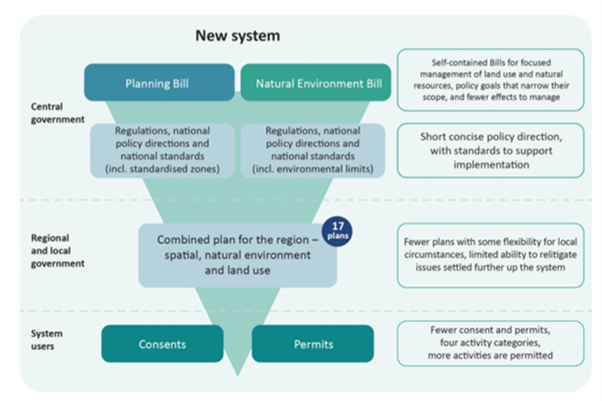
Figure adapted from: Better planning for a better New Zealand | Ministry for the Environment
Transitional system and consent duration
It will take time to fully transition to the new system, and the RMA and all regional and district plans will still be in force during the transition period.
A Transitional framework is included in the bills. This includes:
Consents due to expire during the transition period will be extended to a date two years after the end of the period. The end date is not set and will be decided by Order in Council, once all the plans have been notified. It is likely that current consents will be extended to 2031. The RMA and all planning instruments under the RMA will cease to apply at the end of the transition period.
Some changes to consent duration have already passed into law to make it easier for farmers to transition to a new resource management system. This is what you need to know:
More information: Resource Management (Duration of Consents) Amendment Act | Ministry for the Environment
We advise you to contact your regional council if you have questions about your consent renewal.
We will continue to work with sector partners such as Beef and Lamb NZ, Federated Farmers, Horticulture New Zealand, IrrigationNZ, the Fertiliser Association and Dairy Sector organisations to find alignment.
DairyNZ tested positions with dairy farmer groups and levy payers through webinars and discussions to inform our submission.
Now’s the perfect time to check in, plan, and set up for a strong season. We’ve pulled together smart tips and tools to help you stay ahead all winter long.
Whether you prefer to read, listen, or download handy guides, we’ve got you covered with trusted tools to support your journey every step of the way.
Put our proven strategies and seasonal tools to work. Boost production, support animal health and watch your profits hum.
Tools that are backed by science, shaped by farmers and made for this season.
That’s Summer Smarts.
Autumn Smarts brings together the research-backed tools that build resilience and boost performance.


